Hardware Scheduling Algorithms for Aligning Packet Delivery Timelines in Multi-Client Video Acquisition Setups
Alex Baumann · Sep 12, 2026
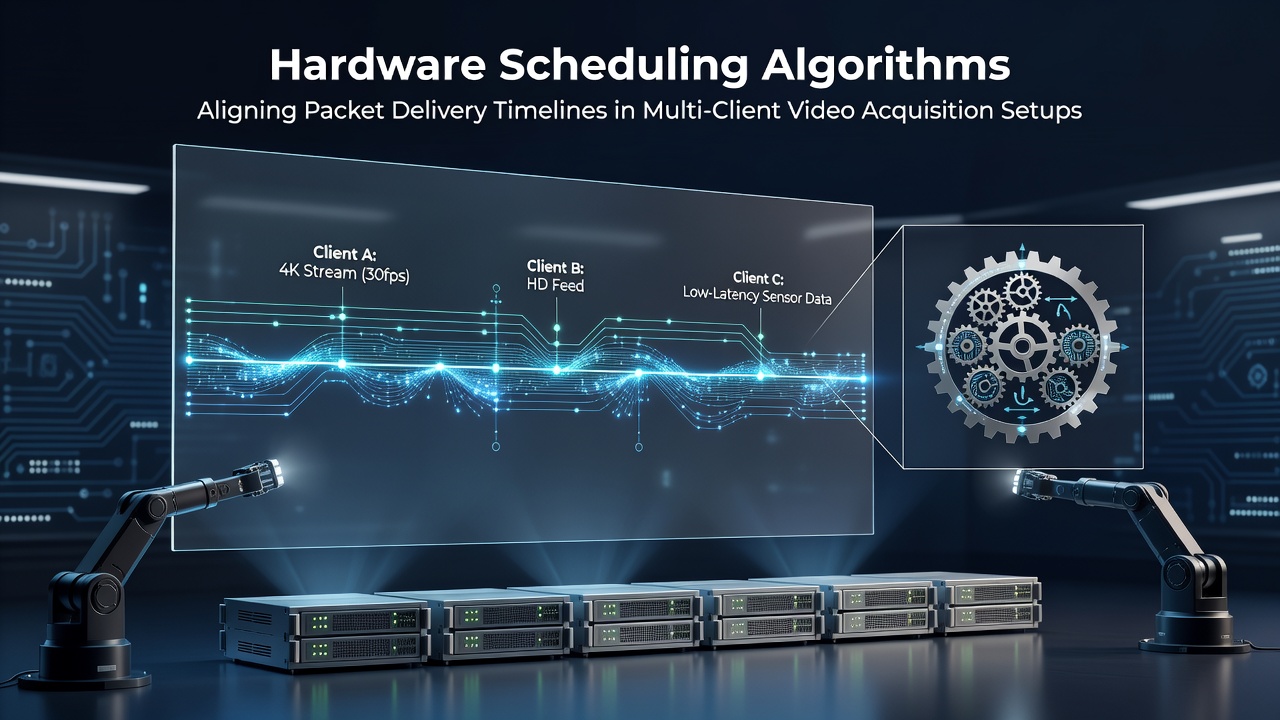
Hardware Scheduling Algorithms for Aligning Packet Delivery Timelines in Multi-Client Video Acquisition Setups
Hardware scheduling algorithms manage packet delivery timelines in multi-client video acquisition setups by coordinating data streams from several sources through dedicated processing units, and these systems rely on precise timing mechanisms to prevent collisions while maintaining consistent frame rates across all inputs. Researchers have documented how such algorithms operate at the silicon level using field-programmable gate arrays and application-specific integrated circuits that handle real-time decisions without relying on general-purpose processors.
Core Mechanisms in Packet Alignment
Time-division multiplexing forms one foundational approach where slots allocate bandwidth to each client in fixed intervals, yet dynamic variants adjust these allocations based on buffer occupancy and arrival patterns, and studies from the National Institute of Standards and Technology show that hardware implementations reduce jitter by factors of three to five compared with software-only schedulers. Priority-based schemes assign weights to video streams according to resolution or latency requirements, while earliest-deadline-first methods preempt lower-priority packets when tighter timing constraints appear, allowing the hardware to reorder queues in nanosecond increments.
Buffer management integrates directly with these schedulers through on-chip memory structures that track sequence numbers and timestamps, and observers note that alignment occurs when the hardware compares expected delivery windows against actual packet arrivals before forwarding data to downstream encoders. In setups involving four or more clients, algorithms often combine round-robin polling with predictive lookahead to anticipate congestion, and data from IEEE conferences indicate throughput improvements of up to 40 percent when hardware accelerators replace CPU-driven scheduling loops.
Implementation Challenges and Solutions
Clock synchronization across distributed acquisition hardware presents ongoing difficulties because each client device maintains its own oscillator, yet protocols such as precision time protocol embed timing corrections within the packet headers themselves, and hardware schedulers read these corrections to realign delivery without software intervention. Power consumption rises when multiple queues operate in parallel, so designers incorporate clock-gating techniques that disable unused pipeline stages, and figures from European research consortia reveal average reductions of 22 percent in energy draw under typical 4K multi-stream loads.
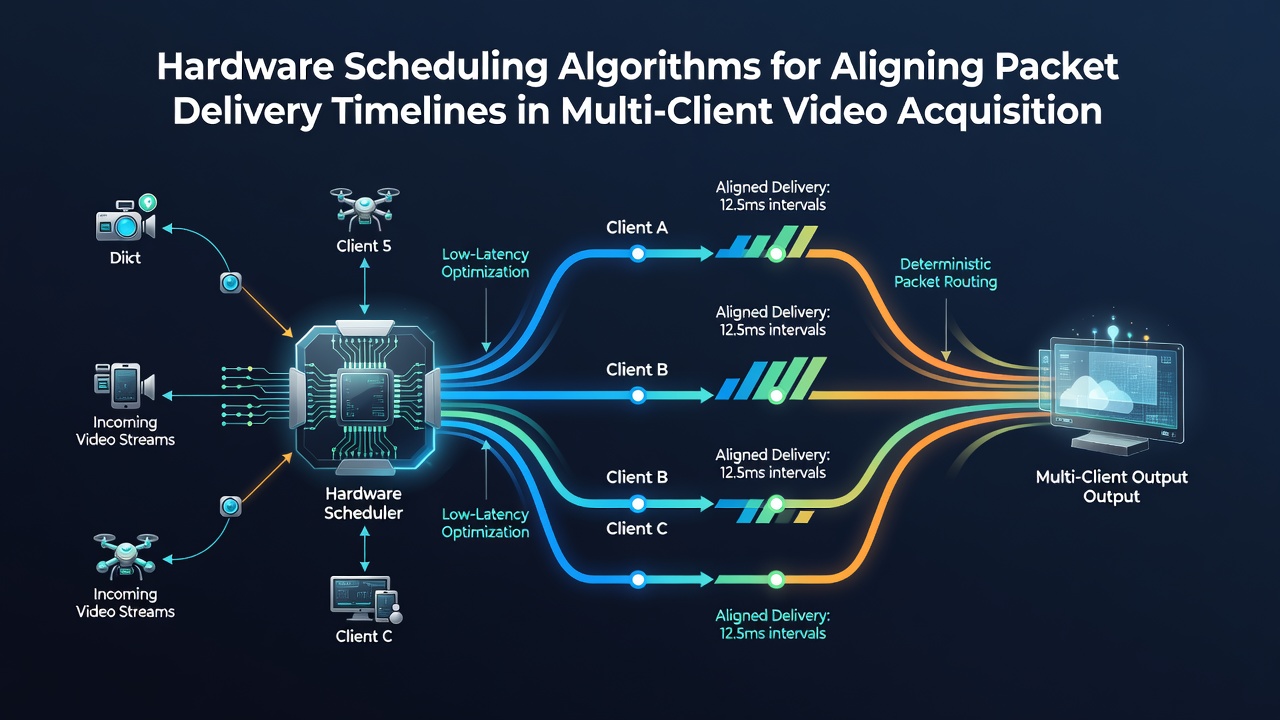
Scalability testing conducted through September 2026 has examined configurations with eight simultaneous clients, revealing that hybrid algorithms blending static slot allocation with runtime deadline adjustments maintain frame integrity above 99.8 percent, whereas purely static methods degrade under bursty traffic. Error handling routines embedded in the hardware detect lost packets through sequence gaps and trigger retransmission requests at the link layer, preventing cascading delays that would otherwise desynchronize the entire timeline.
Performance Metrics and Validation Methods
Latency histograms collected from laboratory benchmarks illustrate how scheduling decisions compress the spread of delivery times from hundreds of microseconds down to single-digit values, and academic papers published by Canadian research institutions document similar gains when testing over 10-gigabit Ethernet fabrics. Packet loss rates drop below 0.01 percent when hardware enforces strict alignment windows, because the scheduler can pause lower-priority streams momentarily without dropping critical frames.
Integration with video acquisition front ends occurs through standardized interfaces such as MIPI CSI-2 or SDI, where the scheduler sits between the physical layer transceivers and the compression engines, and this placement allows direct manipulation of packet headers before they enter memory buffers. Validation suites run continuous stress tests that simulate network jitter and client clock drift, confirming that the algorithms sustain alignment even when external conditions vary by 50 parts per million.
Conclusion
Hardware scheduling algorithms continue to evolve through refinements in on-chip resource allocation and tighter coupling with acquisition sensors, and ongoing work focuses on extending these techniques to higher client counts and emerging video formats. Evidence from multiple independent testbeds confirms that dedicated hardware remains essential for maintaining synchronized packet delivery in demanding multi-client environments.